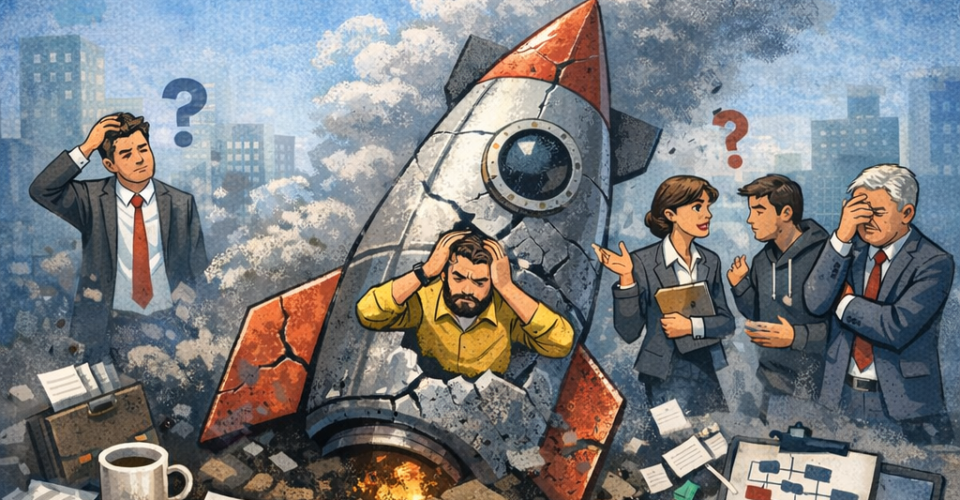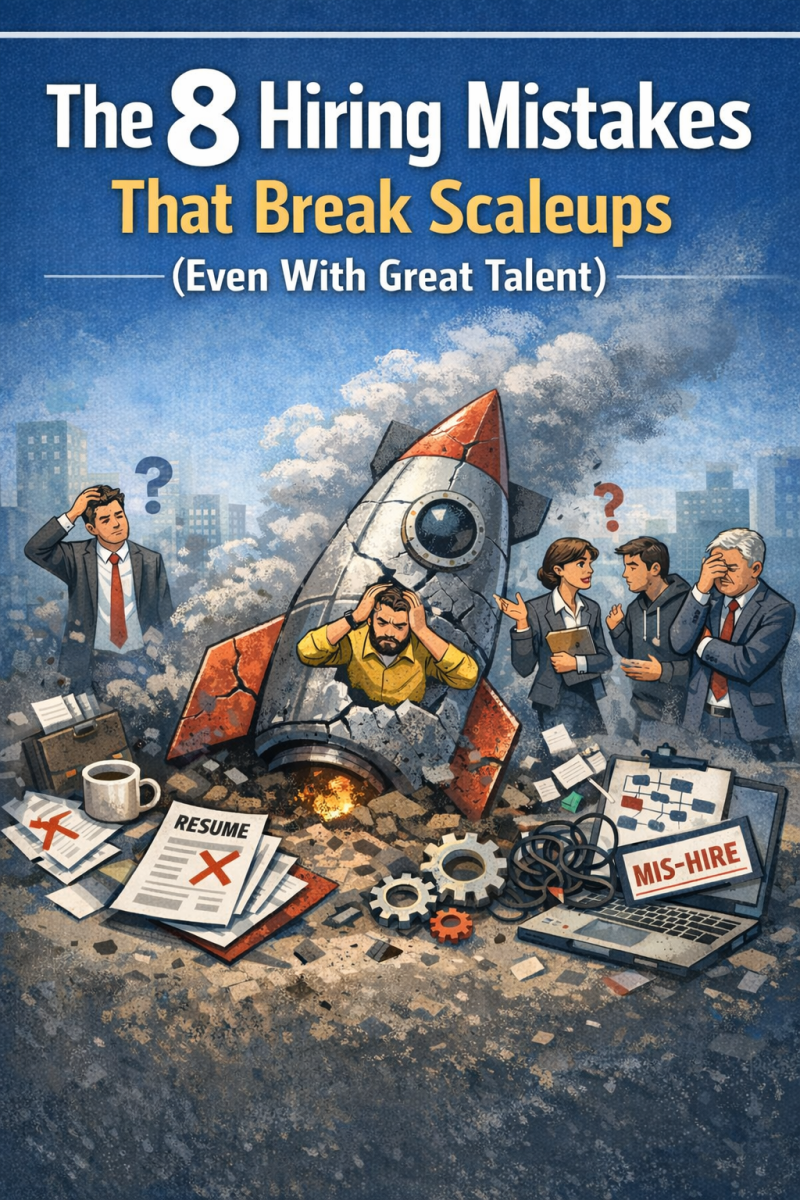

The 8 Hiring Mistakes That Break Scaleups (Even With Great Talent)
February 2, 2026Most CEOs I work with are smart, decisive people. They have built something real. They have cleared the hardest early hurdles — product-market fit, a board that still believes in them, a technical team that is, by any reasonable measure, busy and committed. On paper, everything looks like it is moving.
And yet growth feels stuck. Not dramatically stuck. Not broken. Just slower than it should be, in a way that is hard to name and harder to explain to a board.
After twenty years working inside and alongside engineering organisations at every stage from seed to Series B, I have seen one pattern repeat more consistently than any other. The problem is rarely the technology. It is almost never the talent. It is the structure around them, and the fact that no one has noticed it has stopped working.
When a team is small, ten or twelve or fifteen engineers, a strong CTO can hold everything together through presence alone. They know every codebase, every open decision, every technical risk. That model is not just acceptable at that stage. It is correct. It is how early-stage teams move fast.
Then headcount grows. Fifteen becomes twenty. Twenty becomes thirty. And somewhere in that transition, something quietly breaks.
The CTO is still approving every significant pull request. There is no additional technical leadership to absorb coordination or make the smaller decisions that used to make themselves. Engineers wait. Decisions stack up behind one person. Velocity does not collapse in a single week. It erodes, slowly, in a way that looks from the outside like the team is still busy and productive, because they are. They are just not compounding.
I remember working with a company a few years ago that had scaled from eighteen to thirty-four engineers in under fourteen months. The CEO was proud of the growth. The board was supportive. The CTO was respected and technically very strong. And yet, in our first conversation, the CEO told me something that I have heard in some variation dozens of times since: “We ship constantly but I cannot tell you if we are faster or slower than we were two years ago. “
That sentence is the tell. When a CEO loses the ability to feel the pace of their own technical organisation, the structure has already failed. The signal has been absorbed by noise.
What had happened in that company was straightforward, once you looked for it. The CTO was the single point of approval for anything consequential. There were no team leads with real ownership. Coordination happened in Slack threads and impromptu calls rather than in defined processes. The engineers were talented and motivated. But the system around them had not been designed for the size it had become. It had been inherited from a smaller version of itself and never deliberately rebuilt.
This is not a failure of ambition or effort. It is a failure of design, and it is one of the most common things I see in scaleups between seed and Series B.
The structural question worth sitting with is this: does your engineering organisation have ownership distributed across teams and leads, or does everything still flow through one person at the top? A fund doing diligence for a Series B will ask your CTO exactly that question. They will ask what happens if the CTO leaves. They will ask who has the authority to make architectural decisions on a Monday morning when the CTO is in an investor meeting. They will ask whether the team can sustain its pace or whether it is dependent on one individual’s bandwidth.
If the honest answer is uncertain, that is not just a due diligence risk sitting somewhere in your future. It is a velocity risk you are living with today, in every sprint, in every release cycle, in every week where something is slightly slower than it should be and no one can explain why.
With that in mind, it is worth noting that this kind of structural fragility rarely announces itself. There is no moment of crisis, no incident that puts it on the board agenda. It just quietly depresses what your team is capable of, quarter after quarter, until the gap between what you expected and what you delivered becomes impossible to ignore.
The good news is that this is entirely diagnosable, and you do not need to be technical to do it. The right questions, asked calmly and consistently of the right people, will surface the picture in under an hour. I have developed a free Scaling Scorecard over years of doing exactly this kind of diagnostic work. It covers six domains, thirty questions, no jargon. It takes about twenty minutes to complete and gives you a clear, honest view of where the structure holds and where it does not.
If what you have read here feels familiar, I would encourage you to start there. Download the scorecard below and run it this week. Or, if you would rather talk through what you are already seeing before committing time to a self-assessment, book a free assessment call. I am happy to help you name what is happening before we decide together what to do about it.